Top 5 Kitchen Composters in 2026

As food waste regulations tighten and zero-waste living becomes mainstream, electric composters have surged in popularity—especially among apartment dwellers and urban households. A growing number of devices promise to turn kitchen scraps into something “compost-like” overnight. But here’s the problem:
Not all kitchen composters actually compost.
Most electric kitchen composters don’t make real compost—they just dry, grind, or process food scraps in ways that fall short of true composting. In 2026, consumers are no longer just asking “What’s the best kitchen composter?” They’re asking a more important question:
Does this machine produce real compost—or just dried food waste?
This distinction matters for soil health, sustainability, cost, and environmental impact. In this guide, we’ll review the top 5 kitchen composters of 2026 and explain — clearly and scientifically — why GEME Terra II stands apart.
Comparison Table: Real Compost vs Dehydrated Waste
| Feature | GEME Terra II | GEME Pro | Lomi | Mill | Reencle |
|---|---|---|---|---|---|
| True microbial composting | ✅ | ✅ | ❌ | ❌ | ✅ |
| Produces real compost | ✅ | ✅ | ❌ | ❌ | ❌ |
| Handles meat & dairy | ✅ | ✅ | Limited | Limited | Limited |
| AI condition control | ✅ | ❌ | ❌ | ❌ | ❌ |
| Ongoing filter cost | $0 | $0 | High | Medium | Medium |
| Final output usable in soil | ✅ | ✅ | ❌ | ❌ | ❌ |
1. GEME Terra II — Best Kitchen Composter Overall
Category: True electric composter
Technology: AI-controlled microbial fermentation
Produces real compost: ✅ Yes
Why It Leads in 2026
- Only kitchen system producing real compost
- Handles meat, bones, and dairy safely
- No ongoing filter replacement costs
- No subscriptions
- Odor-free via biological control, not masking
Best for:
Apartment dwellers, zero-waste advocates, gardeners, sustainability-focused households
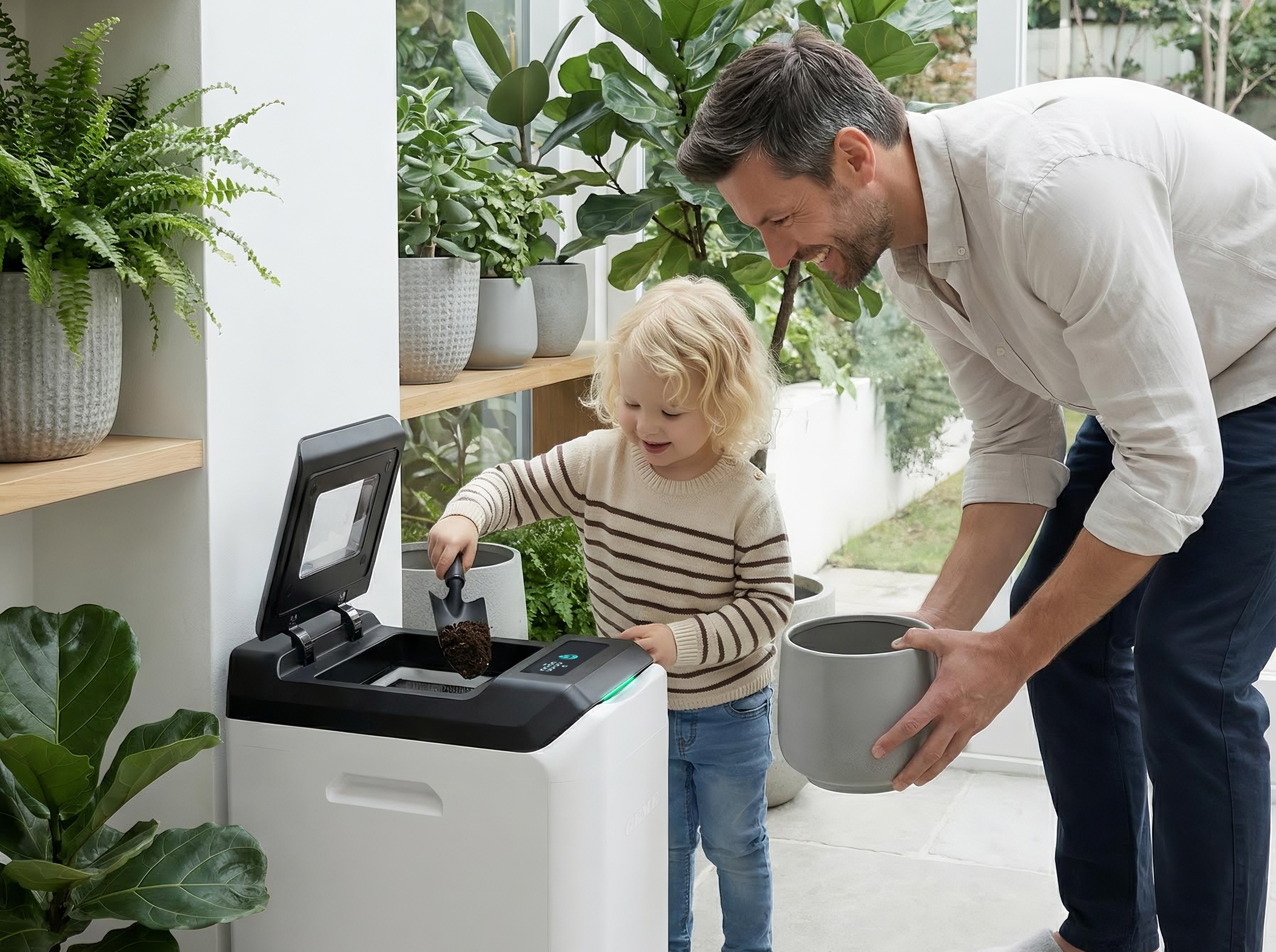
GEME Terra II: The Best Kitchen Composter
✅ Zero Filter Costs, No Refills
✅ Quiet, Odour-Free, Real Compost
✅ Rich Compost Output For Garden Soil & Plants
✅ Reduce Landfill Waste & Greenhouse Gases
Overview
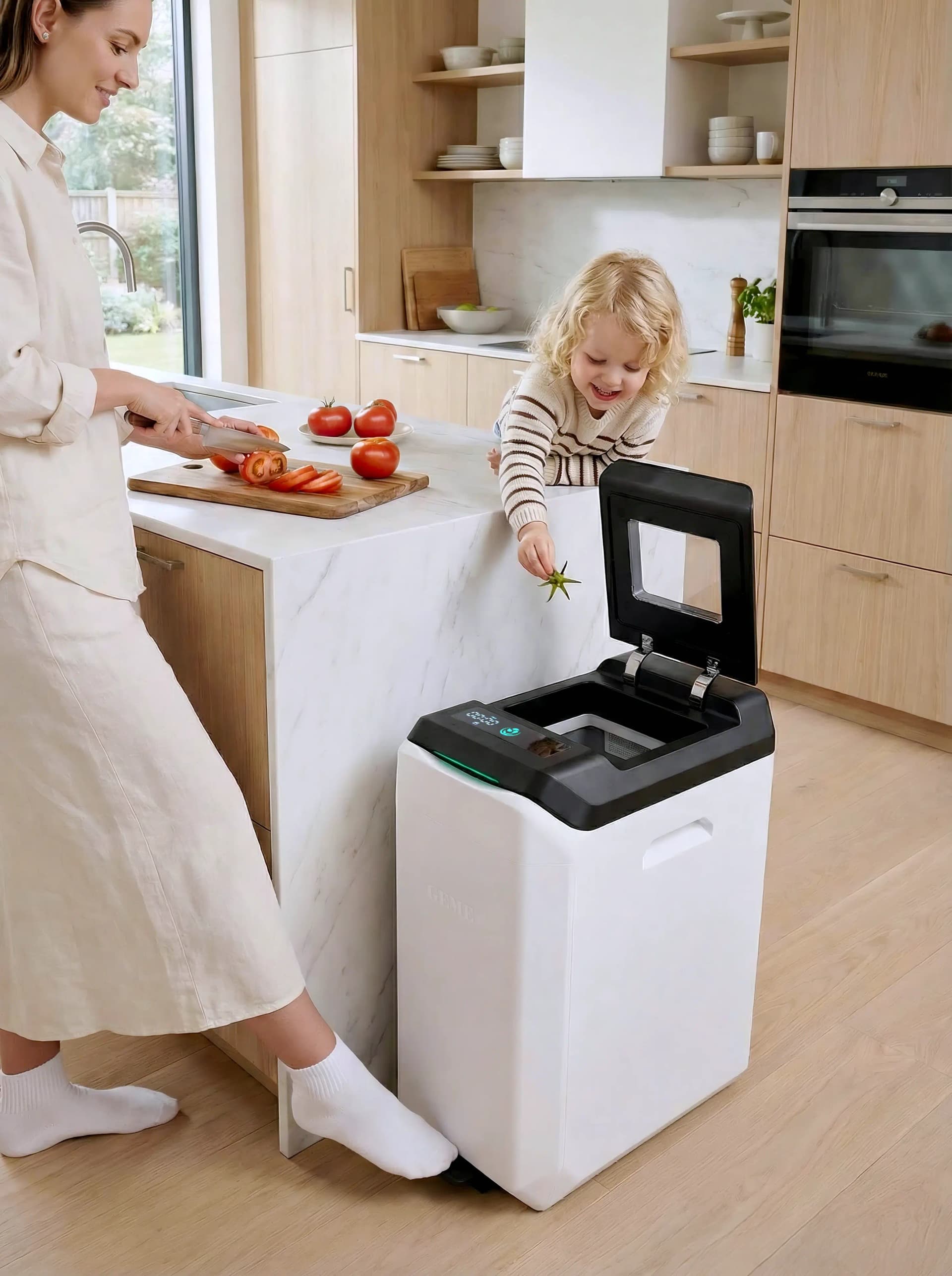
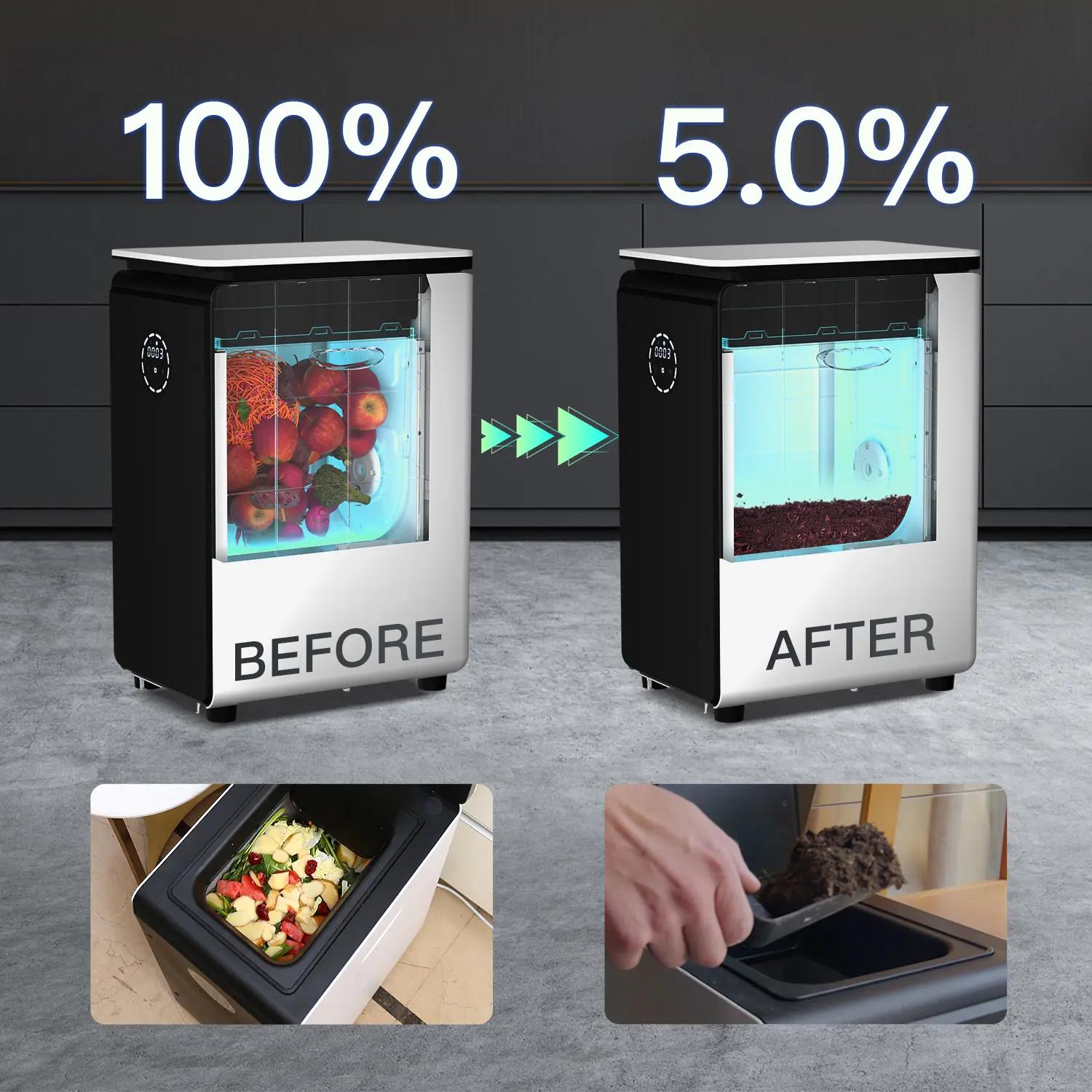
Launched in December 2025, the GEME Terra II is a compact, AI-driven bioreactor that uses high-heat microbes (the proprietary Kobold™ culture) to turn food waste into living compost in 6–8 hours. Unlike “dehydrator” style units, Terra II maintains a Goldilocks Zone (45–55°C) ideal for thermophilic microbes. In practice, Terra II digests up to ~2 kg of food scraps per day (for a small family) and achieves a volume reduction of up to 95%. The output is genuine soil amendment – rich, dark, and microbe-filled – so it can be added directly to plants or gardens.
Key Benefits
Terra II was widely praised at launch as a top-rated kitchen composter. For example, Digital Trends named it among the best smart home tech of IFA 2024, and it won a 2025 design award. It features “zero filter costs” – an industrial metal-ion oxidiser means no charcoal or pods needed ever. In fact, GEME’s own comparison shows Terra II costs about $50 more upfront than typical dehydrator bins, but no refills are needed – saving hundreds over 3 years. It’s also quiet (≤40 dB) and streamlined (11.7×17.2×22.3 inches) to fit most kitchens. You simply toss in peelings, coffee grounds, bones or dairy anytime (the continuous-feed design), and the machine’s AI & microbes handle the rest. No buttons or cycles to manage – just “add & forget” until the timer beeps.
Performance
Terra II excels where others struggle. It heats waste up to ~75°C (killing pathogens), so you can compost meat, fish, bones, even moldy food that most other countertop units can’t. In side-by-side comparisons, Terra II outperformed standard “smart bins” (which only handle dry waste) by actually fermenting scraps into humus-like soil. As one GEME expert put it, Terra II “turns waste into nutrients… making traditional yard composting a thing of the past”. Customer demand has been high – pre-orders for Terra II sold out in hours – a testament to how well this world’s first AI-powered kitchen composter meets real needs.
Why It’s Top Rated
Multiple trusted sources highlight Terra II’s advantages. Wired’s review notes that only the Reencle (another on our list) even approaches real compost, but Terra II actually delivers it consistently. GEME’s own tests back this up: Terra II reduces 95% of waste volume and produces “nutrient-rich soil” ready to feed plants. And unlike other devices, GEME Terra II has no hidden costs – just a one-time purchase (about $549) and no filter subscriptions.
Terra II is offered with incentives, too. GEME provides a 30-day money-back guarantee and free shipping in the US/EU, so you can try it risk-free. Pre-ordering secures the launch price (far cheaper than renting a dehydrator long-term). For tech-savvy greenies, Terra II represents cutting-edge sustainability – pre-order now to join the kitchen composting revolution.
GEME Terra II: The Best Kitchen Composter
✅ Zero Filter Costs, No Refills
✅ Quiet, Odour-Free, Real Compost
✅ Rich Compost Output For Garden Soil & Plants
✅ Reduce Landfill Waste & Greenhouse Gases
Verified Source Citations
[2] Digital Trends: The best smart home tech of IFA 2024
2. GEME Pro — Commercial-Grade Composting at Home
Category: Advanced electric composter
Technology: Industrial-inspired microbial system
Produces real compost: ✅ Yes
Designed for:
- Large households
- Small businesses
- Heavy daily food waste
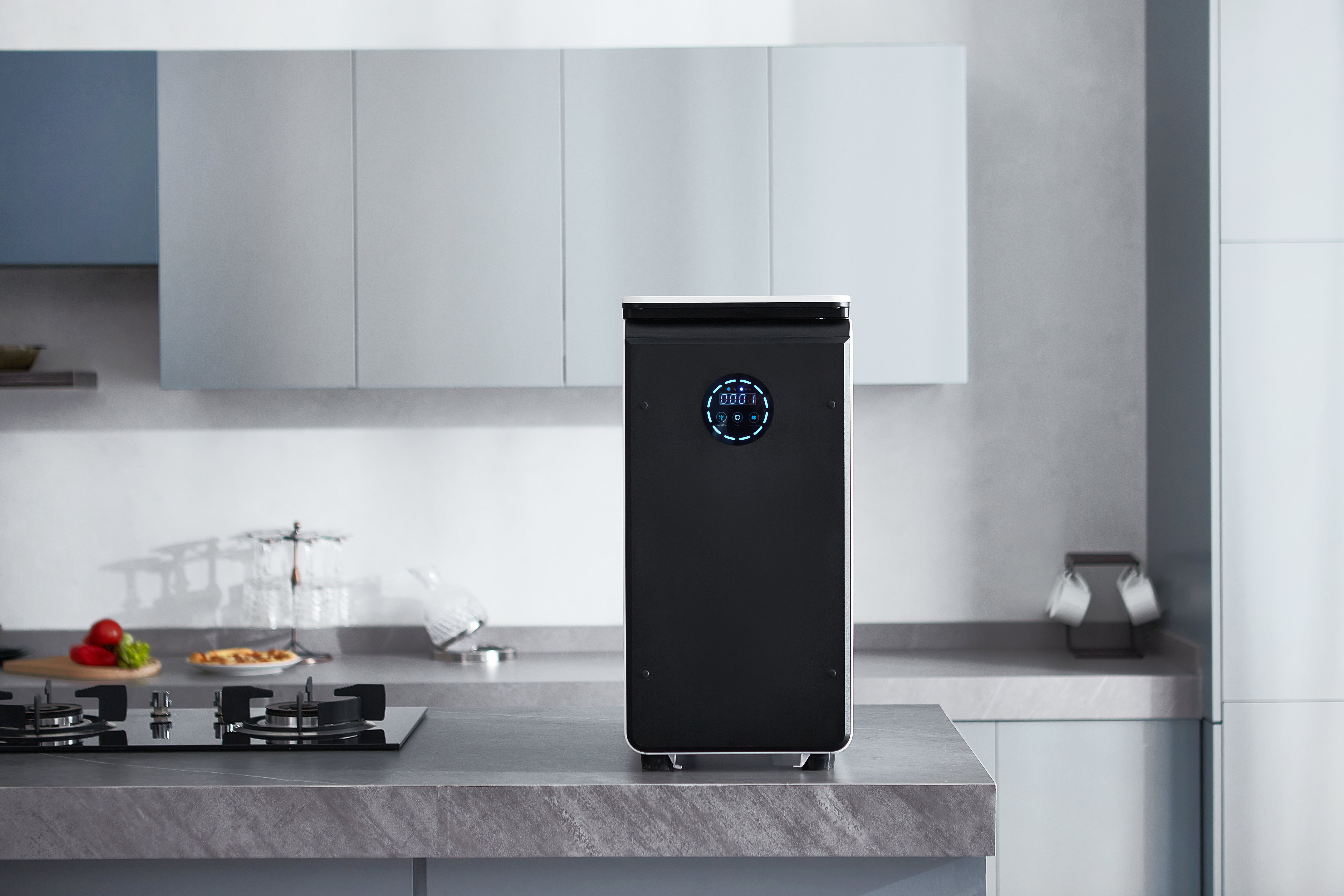
GEME Pro Kitchen Composter
✅ Best Way Of Composting Indoors
✅ Quiet, Odour-Free, Real Compost
✅ Rich Compost Output For Garden Soil & Plants
✅ Reduce Landfill Waste & Greenhouse Gases
Overview
GEME Pro Shares the same composting philosophy as Terra II but with higher capacity and throughput. The GEME Pro (also called GEME I) is GEME’s original model, designed for larger households. It uses the same microbial bio-reactor technology as Terra II (95% volume reduction, real soil output), but with a bigger tank. The Pro can process up to 5 kg of scraps per day and holds 19.5 L. In practice, it’s about 66.5 cm tall and 45.5 cm deep, requiring a bit more space – but it’s ideal if you host dinners or have a busy family (4+ people).
Features
Like Terra II, the GEME Pro is filter-free (no charcoal pod needed) with industrial metal-ion purification. You can dump all food waste into it – meat, dairy, peels, eggshells – just like Terra II, thanks to the same microbe-driven process. It runs continuously (no batch cycles), and again yields mature compost in hours. The Pro is heavier (19.5 kg vs Terra II’s 13 kg), but that sturdiness comes with a powerful rotor (288 lbs of force) and a durable chassis. It’s built to be “the quietest composter on the market” (35–45 dB operational noise), so it won’t disturb an apartment or office kitchen.
Benefits
Apartment or condo dwellers often worry about footprint and smell – GEME addresses both. The Pro vents through metal ion action (no smell) and is rated certified odorless. It’s also energy-efficient (only about 1 kWh per 7‑hour cycle) and runs on a simple plug. Importantly, like Terra II, the GEME Pro has zero ongoing filter or pod costs. Dozens of users report consistent success: “Yesterday I put mozzarella balls and shredded carrots and eggshells – gone like magic,” says one GEME reviewer.
Why It’s Top Rated
Industry watchers praise GEME’s approach: they call it a ”bio waste composter”, not a mere dryer. Indeed, GEME’s tests claim microbial breakdown is ~1000× faster than backyard compost. Wired’s filter-cost analysis confirms GEME’s advantage: GEME Pro (and Terra II) don’t require filter replacements, saving owners hundreds. If you have space and generate lots of scraps, the GEME Pro is unmatched. Plus, GEME offers a 30-day trial and friendly customer support, making it easy to try at home.
GEME Pro Kitchen Composter
✅ Best Way Of Composting Indoors
✅ Quiet, Odour-Free, Real Compost
✅ Rich Compost Output For Garden Soil & Plants
✅ Reduce Landfill Waste & Greenhouse Gases
3. Lomi — Popular, But Not a True Composter
Category: Dehydrator / food recycler
Technology: Heat + grinding
Produces real compost: ❌ No
Lomi dries and grinds food waste into a shelf-stable output. While marketed as compost, the material:
- Contains no living microbes
- Must be composted again
- Relies on frequent charcoal filter replacements
Best described as pre-processing, not composting.
Overview: A Grind-and-Dry Food Recycler, Not a Biological Composter
Lomi 3 is manufactured by Pela as a countertop food recycler that processes organic scraps through grinding and dehydration methods rather than biological composting. Its 3-liter removable bucket is designed to accommodate daily kitchen waste such as fruit and vegetable scraps, coffee grounds, and limited soft food items. Users activate one of Lomi’s cycle modes and return hours later to collect the processed material. The device is described on the official product page as transforming food scraps into “nutrient-rich dirt” in just a few hours, emphasizing convenience, quiet operation, and odor control via a charcoal filtration system.
On its site, Pela highlights the device’s capabilities as a waste-reducing recycler that produces “Lomi Earth”—a soil-like output that can be applied to gardens, lawns, or municipal compost bins after mixing into additional soil.
However, technical analyses from reviewers and third-party sources repeatedly note that the material Lomi 3 produces is dehydrated or ground organic matter rather than finished biological compost as defined by traditional compost science. This output must often be blended with existing soil at recommended ratios before benefiting plants, and it does not undergo the same microbial decomposition processes that characterize true composting.
Features & Performance: High Convenience, Biological Limitations
From a convenience perspective, Lomi 3 offers several user-friendly features:
- One-button activation or smartphone app control
- Transparent lid for visual monitoring
- Advanced carbon filters for odor mitigation
- Compact design suited for kitchen countertops
- Multiple cycle modes such as “Eco-Express” and “Grow” for different waste types and speeds
These features allow Lomi to break down or reduce the volume of organic scraps quickly. According to product guides, carbon filters absorb odors, but they require regular replacement (typically after about 45 cycles or sooner, depending on waste type), making the filtration system a consumable cost as opposed to a one-time installation.
Lomi’s user documentation instructs customers to replace the carbon filter pellets when odor increases or the indicator lamp signals a change, reinforcing that odor management depends on consumable replacements.
In addition, independent reviewers note that Lomi’s dehydrative process reduces waste volume (often cited at around 80%) but produces a material that is best described as dehydrated organic matter or pre-compost rather than finished compost. For example, a gardening review describes the output as something that should be mixed with soil at a 1:10 ratio for best use, reflecting that it lacks the mature, biologically active properties of traditional compost.
Consumer Feedback: Design Improvements and Persistent Trade-Offs
Early iterations of Lomi (e.g., Lomi 2) encountered some design complaints, such as lid durability issues. Independent reviews (such as by Wired) on earlier models mention lid warping over time, which could compromise odor control until resolved by redesign.
Many reviews praise Lomi 3’s usability and reduced noise compared to older models, noting its “thoughtfully engineered, easy-to-use” interface. However, multiple reviewers also emphasize that its output does not equate to traditional compost. As one review points out, after processing, the material often needs to be mixed with soil before it can effectively support plant growth—or added to an existing outdoor compost system to complete decomposition.
A garden sustainability analysis further clarifies the product’s framing: industry edges toward calling the end product “pre-compost” or “fragmented waste,” rather than compost by scientific definition, because the material lacks the fully stabilized biological structure typical of finished compost.
Costs & Ongoing Commitments: Convenience Comes With Recurring Expenses
Lomi 3’s upfront price is typically around $499–$549, placing it in the premium end of countertop waste processors. In addition to the unit cost, ongoing maintenance requires periodic carbon filter replacements, which are not negligible when considered over longer durations of use. Installation of new filters is recommended as odor begins to increase or as the filter indicator light activates after many cycles.
While some users appreciate the convenience of automatic filter delivery via subscription, such ongoing consumable costs are part of the device’s operational profile and contribute to total cost of ownership beyond the initial purchase.
Why Lomi Often Appears on “Top Rated” Lists — And Why Context Matters
Lomi 3 frequently appears on lists of well-rated kitchen waste processors due to its strong consumer design, ease of use, and effective odor management. Publications and independent reviewers often highlight its ability to shrink waste volume, reduce kitchen trash, and provide a relatively mess-free waste processing solution.
However, when discussing best kitchen composters, it’s important to contextualize what Lomi does and does not do: it reduces the volume of food waste and produces a controlled dry output, but it does not perform true biological composting. Its output is not the same as finished compost and typically requires blending with existing soil or further decomposition in outdoor or municipal compost systems.
Verified Source Citations
[1] Product details and marketing claims about operation and output
[2] Cartridge filters and replacement guidance
[3] Independent commentary on grind/dehydrate output and soil mixing needs
[4] Lomi review
[5] Context on pre-compost nature of output
GEME Terra II: The Best Kitchen Composter
✅ Zero Filter Costs, No Refills
✅ Quiet, Odour-Free, Real Compost
✅ Rich Compost Output For Garden Soil & Plants
✅ Reduce Landfill Waste & Greenhouse Gases
4. Mill Food Recycler — Waste Reduction, Not Compost Creation
Category: Food waste processor
Technology: Low-heat drying
Produces real compost: ❌ No
Mill focuses on:
- Odor control
- Trash reduction
- Centralized waste processing
Its output is not compost and requires off-site handling.
Overview: Large-Scale Grind-and-Dry Food Recycling
The Mill Food Recycler is a freestanding, trash-can-style kitchen appliance designed to reduce household food waste volume through heat-based dehydration and grinding, not biological composting. With a 9-gallon (approximately 40-pound) capacity, Mill is positioned for high-output households and frequent cooks rather than small apartments.
Mill describes its system as heating and grinding food scraps overnight to reduce volume and odor, producing a dry, shelf-stable material referred to as “grounds.” According to both Mill and independent reviews, the device typically runs on 8–12 hour overnight cycles, using heat and mechanical processing to shrink waste volume by roughly 70–80%.
Importantly, Mill does not claim to produce finished compost. Instead, the output is a dehydrated organic material that must be:
- Added to an outdoor compost system
- Sent to municipal or farm composting programs
- Collected through Mill’s own pickup service
This distinction is consistently acknowledged by reviewers and aligns with compost science definitions used by agricultural authorities.
Features & Performance: Capacity and Automation Over Biology
Mill is engineered for maximum input flexibility. According to product documentation and third-party testing, it accepts:
- Fruit and vegetable scraps
- Meat, dairy, and cooked foods
- Coffee grounds and eggshells
- Small bones (with limitations)
The device uses a powerful motor and internal grinding system, combined with heat, to process mixed organic waste without pre-sorting. Sensors automatically detect fill levels and initiate processing on a preset schedule, allowing users to continuously add scraps throughout the day.
Reviewers note that Mill is relatively quiet during overnight operation and largely odor-free during normal use. Odor control relies on internal filtration and the dehydration process itself, rather than microbial activity.
However, because Mill relies on thermal drying rather than microorganisms, its output:
- Contains no active composting microbes
- Is biologically inert at completion
- Requires external composting or soil systems to finish decomposition
This limitation is clearly noted in expert reviews, including Wired’s buying guide, which categorizes Mill as a food recycler, not a true composter.
Convenience Programs & Ongoing Costs
One of Mill’s differentiating features is its optional collection service. For an annual fee (reported by Mill at approximately $192/year), the company provides special liners and coordinates USPS pickup of the dried output, which is then sent to partner farms for composting.
This program allows users without gardens or municipal compost access to divert food waste from landfills, but it also reinforces an important point: Mill does not complete the composting process inside the home.
Pricing places Mill at the premium end of the category:
- Approximate retail price: 1,150
- Optional annual pickup subscription
- Financing and rental options (around $35/month)
Mill offers a 90-day trial, which reviewers frequently cite as a risk-reduction factor for prospective buyers.
Why Mill Is Often Top-Rated — With Clear Trade-Offs
Mill frequently appears in “top rated composters” lists due to:
- Unmatched capacity
- Minimal daily effort
- Strong odor control
- Proven waste diversion at scale
Wired highlights Mill as the largest-capacity home food recycler available, while Bon Appétit describes it as one of the most effective tools for reducing kitchen waste volume.
That said, both publications explicitly note that Mill:
- Does not produce finished compost
- Functions as a pre-processing system
- Depends on external composting pathways to complete the cycle
Bottom line: Mill is ideal for households focused on waste reduction and convenience, not for users seeking real compost output at home.
Verified Source Citations
5. Reencle — Semi-Automated, Still Filter-Dependent
Category: Hybrid processor
Technology: Heat + microbial mixing
Produces real compost: ❌ No
Reencle produces pre-compost that needs further curing but:
- Requires annual filter replacements
- Cannot complete the composting cycle independently
Overview: Microbial Fermentation Instead of Pure Heat
The Reencle Prime positions itself differently from grind-and-dry recyclers by using a microbial fermentation system rather than dehydration alone. It is a countertop electric composter with a 14-liter capacity, designed to break down food waste using heat and a proprietary microbial inoculant.
According to Wired, Reencle ships with a starter mix called ReencleMicrobe, composed of charcoal, wood pellets, glucose, and multiple microbial strains that initiate biological breakdown inside the unit.
Unlike dehydrators, Reencle’s process aims to partially digest organic matter, producing a soil-like and sawdust-like output that can be cured into usable compost with minimal additional steps.
Features: Broad Feedstock Acceptance and Hands-Free Design
Reencle Prime accepts a wide range of kitchen waste, including:
- Fruits and vegetables
- Meat and dairy
- Cooked foods and leftovers
- Eggshells and soft scraps It does not recommend large bones or hard pits.
Key design features include:
- Sensor-activated lid for hands-free loading
- Internal agitation and warming
- Built-in carbon filter (no disposable pods)
- Simple cycle selection via app or control panel
Noise levels are reported at around 30 dB, which Wired describes as nearly silent, especially compared to grind-and-dry units.
Performance: Near-Compost With a Short Cure Period
In testing, Wired describes Reencle’s operation as similar to a “warm trash can” that continuously digests waste. Scraps are reduced within hours to a day, producing a material resembling a blend of dirt and sawdust.
Crucially, Reencle’s output:
- Contains partially decomposed organic matter
- Requires a short curing period (about 2–3 weeks) when mixed with soil
Reencle recommends mixing the output with soil at approximately a 1:4 ratio before use, after which it can support plant growth. This makes Reencle one of the few countertop systems that nearly approaches real composting rather than simple waste drying.
The company claims up to 90% waste reduction, which aligns with reviewer observations when the unit is properly maintained.
Why Reencle Is Frequently Ranked “Best Overall”
Wired names Reencle Prime the “best overall” kitchen composter, citing:
- Minimal user intervention
- Broad waste acceptance
- Output that is close to real compost
- Lack of required consumable pods
Trade-offs include:
- Larger physical footprint
- Need for periodic curing outside the machine
- Higher upfront cost compared to dehydrators
Reencle offers a 60-day risk-free trial and a one-year warranty (extendable), allowing users to validate performance at home.
GEME Terra II: The Best Kitchen Composter
✅ Zero Filter Costs, No Refills
✅ Quiet, Odour-Free, Real Compost
✅ Rich Compost Output For Garden Soil & Plants
✅ Reduce Landfill Waste & Greenhouse Gases
Verified Source Citations
Why Real Compost Is the Future of Kitchen Composting
For years, consumers accepted dehydrated waste as “good enough.” In 2026, that mindset is changing.
Why This Matters
- Environmental integrity: Composting completes the nutrient cycle
- No greenwashing: Drying waste ≠ composting
- Lower lifetime cost: No filters, no subscriptions
- True zero-waste living: Nothing leaves your home unfinished
Skip the Filters, Skip the Subscriptions
Most “top-rated composters” come with:
- Ongoing charcoal filter costs
- Replacement schedules
- Subscription pressure
GEME Terra II has none of that. Once you own it, you own the full system—forever.

The Only Kitchen Composter That Finishes the Job
If your goal is to:
- Reduce waste and
- Create compost and
- Feed plants, soil, and gardens
Then a dehydrator simply isn’t enough. GEME Terra II doesn’t prepare waste for composting, it completes it.
Final Verdict: The Best Kitchen Composter of 2026
If we define best composter honestly—not by marketing claims but by biology—then the conclusion is clear:
- Best electric composter: GEME Terra II
- Best kitchen composter: GEME Terra II
- Most future-proof composter: GEME Terra II
Because in 2026, the best composters don’t just reduce waste. They return nutrients to the earth.
Ready to Compost for Real? 🌱 Discover GEME Terra II:
GEME Terra II: The Best Kitchen Composter
✅ Zero Filter Costs, No Refills
✅ Quiet, Odour-Free, Real Compost
✅ Rich Compost Output For Garden Soil & Plants
✅ Reduce Landfill Waste & Greenhouse Gases
Related Articles
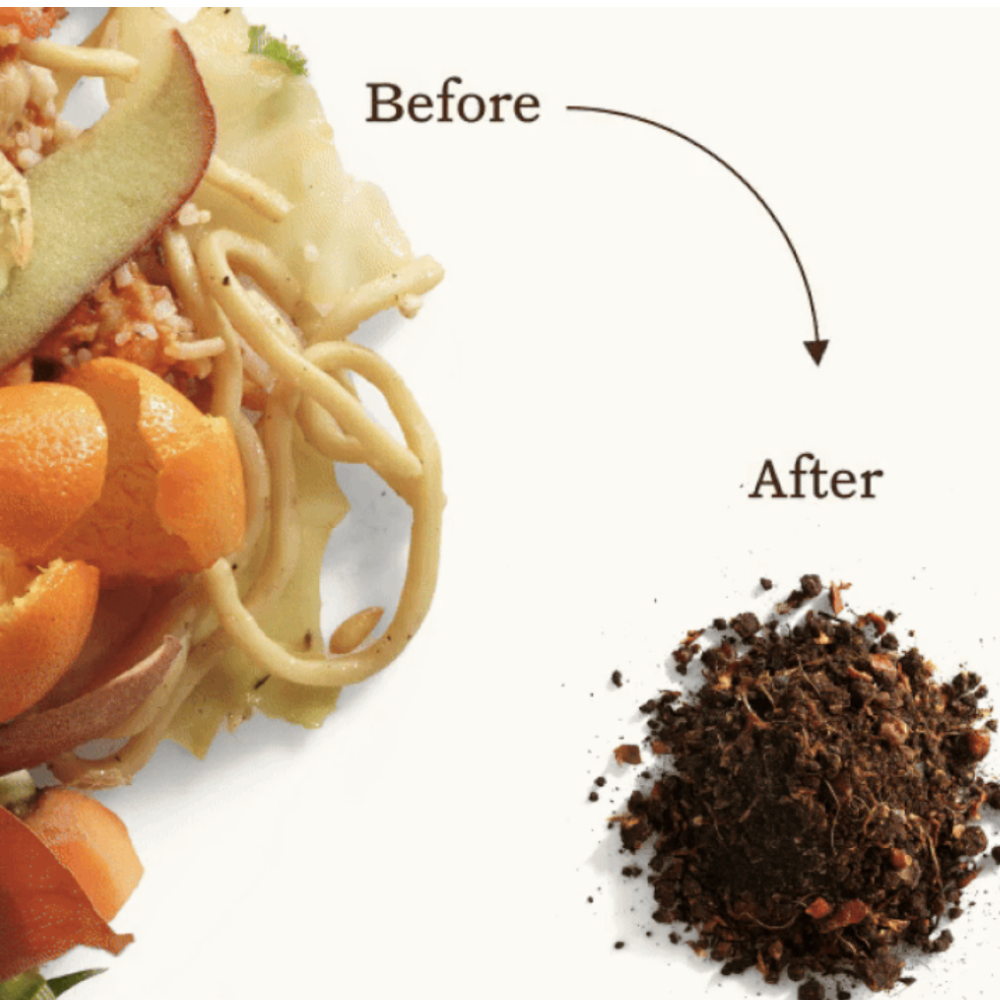
Mastering the GEME Cycle: An Agronomist’s Guide to Continuous-Flow Compost Application
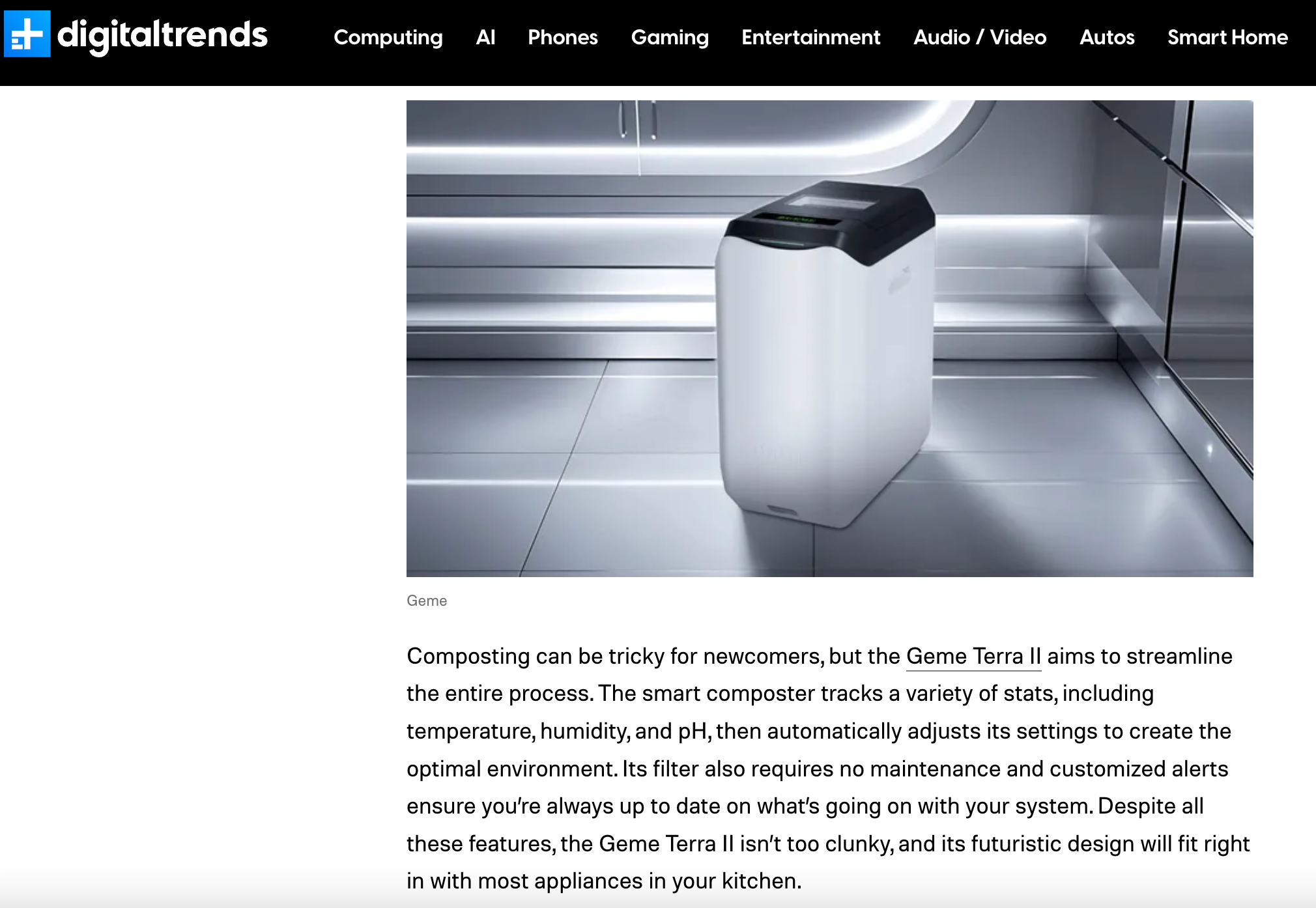
Best Kitchen Composters in 2026: GEME Terra II Redefines “Real Compost”
GEME Terra 2 vs Reencle Composter: 2 different Microbial Composting Approaches
GEME Terra 2 vs Mill Composter: The 2026 Decision Guide
The Best Electric Kitchen Composter of 2026

Mastering the GEME Cycle: An Agronomist’s Guide to Continuous-Flow Compost Application
Geme Terra 2 vs Lomi: Which Countertop Composter Is Better for a Zero Waste Home?
Electric Compost Bin Filters Cost: GEME vs Lomi vs Mill vs Reencle
Bio-Composting Breakthroughs: GEME Terra 2 Debuts, An Easier & Smarter Way To Compost At Home

Can You Compost Bread?
Can I Compost Spoiled or Moldy Fruit Like Grapes? Here's A Practical Guide
Composting Basics: Backyard Compost Pile VS GEME Electric Composter

How Can We Make Bananas Last Longer?

How Long Do Apples Last in The Fridge? An Ultimate Guide For You to Keep Apples Fresh
The Best Kitchen Composter For Reducing Food Waste | Which One is Your Favourite?
Ready to transform your gardening game? Subscribe to our newsletter for expert composting tips and sustainable gardening advice.